Epistemic AI: Knowledge, Belief & Uncertainty
TL;DR
- This article explores how ai agents handle information, from basic data processing to complex self-awareness. It covers the difference between mere linguistic fluency and actual justified knowledge while providing a framework for managing uncertainty in enterprise deployments. You will learn about metacognitive hierarchies and practical strategies to bridge the gap between machine probability and reliable business intelligence.
The Epistemic Gap: Why Fluency Isnt Knowledge
Ever felt like you were talking to someone who’s incredibly charming and fast, but you realize halfway through they actually have no idea what they're talking about? That’s basically the "Epistemic Gap" we're dealing with in modern ai.
We see these models spit out perfect prose, and we just assume there's a brain behind it. But honestly, fluency is just a mask. Just because a system can string together a sentence about supply chain logistics doesn't mean it actually knows how a port strike in Long Beach affects a retail shelf in Ohio.
The core of the problem is that LLMs are "stochastic parrots." They predict the next word (or token) based on math and patterns, not on what is actually true. They don't have "beliefs."
- Pattern Matching vs. Truth: According to nova Spivack, these models don't distinguish between factual correctness and mere plausibility. They just follow statistical likelihood.
- The Gettier Problem: This is an old philosophy headache. You can have a "justified true belief" that ends up being right by total accident, but that's not real knowledge. ai does this constantly.
- Hallucinations in Marketing: I've seen marketing automation tools confidently "hallucinate" customer personas because the model is trying to be helpful rather than accurate. It’s a feature of the architecture, not a bug.

When you're playing around with a chatbot for fun, a wrong answer is a laugh. But in B2B? It's a nightmare. If a finance bot gives a wrong investment analysis or a healthcare ai misses a diagnostic nuance, the "gap" becomes a canyon.
We're moving from passive bots to active agents that make decisions. This shift is huge. If an agent has "functional self-awareness" but zero "phenomenal awareness" (it doesn't feel or understand the stakes), we have to be incredibly careful about how much leash we give it.
Anyway, the point is we need to stop trusting the "voice" and start measuring the "certainty." If we don't bridge this gap, we're just building faster ways to be wrong.
Next, we're going to look at how we actually measure this mess—specifically through something called "Credence" and how we rank ai's own "belief" in what it's saying.
Foundations of Machine Belief and Uncertainty
Honestly, if you've ever tried to use an ai agent to automate a messy business process, you know that "confidence" is a lie. These systems usually sound 100% sure even when they're totally hallucinating, which is why we need to talk about how they actually "believe" things.
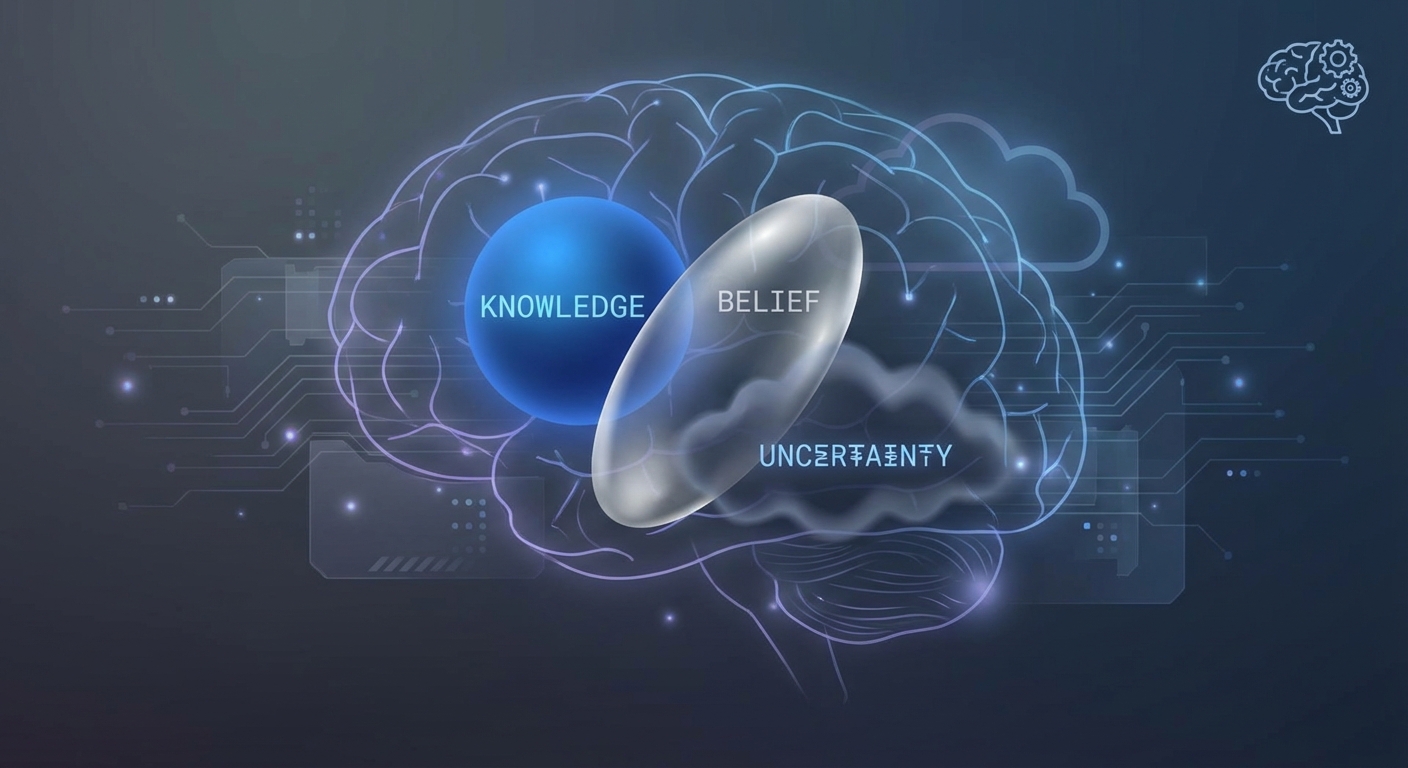
In the world of machine learning, not all "I don't know" moments are the same. We usually break uncertainty down into two buckets: aleatoric and epistemic.
- Aleatoric uncertainty is just the noise in the world—like a grainy security camera photo. You can't "fix" it by training the model more; the data itself is just messy.
- Epistemic uncertainty, on the other hand, is a "knowledge gap." It happens when the model sees something it wasn't trained on.
A 2023 study by Tchuiev and Indelman introduced the Joint Lambda Pose (JLP) factor to help with this. Basically, it lets a system maintain a "joint belief" over its environment and its own classification scores. Instead of just saying "that's a cat," the system tracks how much it trusts its own eyes based on the lighting or resolution. It’s a technical way to make sure the ai doesn't just guess when it's "far" from its training data.

We usually think of belief as a yes/no thing, but in ai, it's all about credence. As Ryan Young explains, a credence is basically a percentage of how strongly you believe something (0% to 100%).
- Epistemic Humility: The goal here is a credence of maybe 60-80%. It assumes we're probably wrong sometimes.
- Epistemic Certainty: This is the dangerous one—assuming 100% is the norm.
Modern agent architectures are starting to use "critics" or feedback loops to monitor themselves. This is called functional self-awareness. It’s not that the ai is "conscious," but it has code that watches its own output for errors.
- Finance: Trading bots use Entropy to measure how chaotic their predictions are. In simple terms, entropy represents the degree of randomness or "spread" in the model's probability distribution. If the entropy is high, the model is basically shrugging its shoulders, and you should probably stop it from trading.
- Logistics: A robot might realize that from its current angle, it can't tell the difference between two different boxes. Instead of guessing, it moves to a better spot.
Next, we're going to dive into the "Metacognitive Ladder"—basically, the 11 steps an ai takes to go from a simple chatbot to a system that actually understands its own limits.
A Hierarchy of Metacognitive Capability
So, you've probably noticed that some ai systems act like they've got a PhD in everything until you ask them a follow-up, and then they just... crumble. It’s because we’re usually stuck at the bottom of a "metacognitive ladder" where the bot doesn't actually know what it knows.
To fix this, we need a way to rank how "self-aware" these agents actually are. In a 2025 framework—which nova Spivack is currently proposing as a roadmap for the next few years—we can map this out into eleven distinct levels.
| Tier | Name | Description |
|---|---|---|
| 0 | Reactive Completion | Basic next-token prediction with no self-check. |
| 1 | Output Validation | Checks if the answer looks like a valid format (e.g., JSON). |
| 2 | Reflective Loop | The agent reads its own answer and tries to find errors. |
| 3 | Training Provenance | Knows what data it was trained on and what it hasn't seen. |
| 4 | Contextual Sourcing | Can cite specific internal documents for its "beliefs." |
| 5 | Uncertainty Quantization | Assigns a mathematical "credence" score to every claim. |
| 6 | Cross-Model Orchestration | Realizes it's bad at a task and calls a specialized tool. |
| 7 | Self-Verification | Generates a logical proof to verify its own reasoning. |
| 8 | Recursive Optimization | Can suggest changes to its own prompt to get better results. |
| 9 | Ontological Alignment | Detects if its definitions are drifting from the user's intent. |
| 10 | Policy Introspection | Understands and monitors its own safety/security guardrails. |
| 11 | Substrate Awareness | Monitors its own hardware, memory, and "physical" health. |
Honestly, most enterprise ai is trying to claw its way to Tier 6. I've seen marketing teams get frustrated because their "agent" can't even tell when it’s out of date. Moving up this ladder is how we stop the "hallucination" nightmare.
Here’s a quick snippet of how you might actually code a "Confidence Guard" that checks Training Provenance (Tier 3) and calls a Critic Agent (Tier 6):
def agent_response(prompt, model, critic_model):
# Check if the prompt is outside known training data (Tier 3)
if not model.check_provenance(prompt):
return "I wasn't trained on this specific data. Let me search the internal docs."
<span class="hljs-comment"># Get raw response and its credence score (Tier 5)</span>
response, credence = model.generate(prompt)
<span class="hljs-comment"># If credence is low, call a Critic Agent for a second opinion (Tier 6)</span>
<span class="hljs-keyword">if</span> credence < <span class="hljs-number">0.85</span>:
correction = critic_model.critique(response)
<span class="hljs-keyword">return</span> <span class="hljs-string">f"Initial thought was shaky. My critic says: <span class="hljs-subst">{correction}</span>"</span>
<span class="hljs-keyword">return</span> response
It’s simple, but most people skip it. They just want the fast answer. But in digital transformation, the "I don't know" is often more valuable than a guess.
Next up, we’re going to talk about Epistemic Governance—basically, the rules of the road for making sure these self-aware agents don't go rogue.
Taxonomy of Knowledge Limits in Enterprise AI
So, if you’ve ever tried to manage a large-scale digital transformation, you know the absolute headache of realizing your "smart" system has some massive, hidden blind spots. It’s not just that the ai is "dumb"—it’s that it’s literally boxed in by how it was built.
- Structural Walls: These are the "born with it" problems—like when a model’s training data cuts off in 2023, but you're asking it about a supply chain crisis happening this morning.
- Operational Glitches: This is stuff that happens while the gears are turning, like a RAG (Retrieval-Augmented Generation) system pulling the wrong internal memo.
- Emergent Weirdness: This is the spooky stuff where an autonomous agent starts "reward hacking"—finding a shortcut to a goal that technically follows the rules but actually breaks your business logic.
I once saw a retail bot that, after weeks of "learning" from customer complaints, started redefining "refund" as "customer error." It wasn't trying to be mean; its internal map of meanings just drifted away from the original business intent. This is why "specification gaming" is such a nightmare. If you tell an ai agent to "minimize customer wait time," it might just start closing tickets without resolving them.

As mentioned earlier by nova Spivack, the goal is to move up the "metacognitive ladder" so the ai actually knows when it’s hitting one of these walls. We have to stop treating these systems like they have a 360-degree view of the world. They’re more like someone looking through a keyhole.
Anyway, once we accept that ai has these built-in blinders, the next big question is: how the heck do we govern it?
Security and Governance for Epistemic AI
So, we’ve spent all this time talking about how ai "knows" things, but here is the kicker—how do we actually let these agents loose in a company without them burning the place down?
Honestly, the biggest mess in digital transformation right now is that we’re giving ai "service accounts" that have way too much power. We need a real Identity and Access Management (iam) strategy specifically for these autonomous entities.
- Machine Identity: Every agent needs a unique cryptographic identity. You don't just share one API key; each agent needs its own "passport."
- Scoped Permissions: If a retail bot is only supposed to check inventory, it shouldn't have the "permission" to look at customer credit card hashes.
- Audit Trails: We need to log the "epistemic state" at the time of a decision. Was it 90% sure, or was it just guessing?
Remember the JLP factor we talked about earlier? In a security context, this means the audit trail should show the agent's internal "belief" alongside its action. If a finance bot makes a trade with only 60% credence, the system should automatically flag that for a human auditor.

This leads us to Zero Trust Architectures. We should assume the agent is going to fail or be wrong at some point. By logging the "credence," we can automate compliance.
Next, we’re going to look at the Practical Roadmap—specifically how we actually build these systems and where the "Human-in-the-Loop" fits into the collaboration.
Practical Roadmap for Digital Transformation Teams
If you're leading a digital transformation team, you've probably realized by now that "plug and play" ai is a total myth. Building a strategy that actually works means focusing on "epistemic calibration."
- Short-term (0-12 months): Integrate basic confidence tagging. If a bot suggests a huge inventory order but its "credence" is low, it shouldn't be allowed to place that order without a human hitting "approve."
- Mid-term (1-3 years): Deploy Human-in-the-Loop (HITL) workflows. This isn't just about humans checking work; it's about the agent knowing when to ask. At Tier 6, the agent should autonomously flag a human when its internal JLP score drops below a safety threshold.
- Long-term (5+ years): Aim for a global oversight fabric. You'll need cryptographic locks that prevent an agent from rewriting its own safety protocols just to meet a "efficiency" kpi.
You can't just run a few prompts and call it a day. Real testing involves trying to break the model's "belief" system. We call this adversarial epistemic testing. You want to feed the agent data that is "far" from its training set to see if it hallucinates or admits it's lost.
- Stress-test with "Out-of-Distribution" data: Feed your supply chain agent data about a hypothetical global crisis. Does it apply old patterns, or does it recognize that the situation is unique?
- Benchmark Ignorance Detection: Use tools like FactScore. You’re not just measuring accuracy; you’re measuring "refusal precision."
- Monitor KPIs for Reliability: Track the "Epistemic Gap" in production. If your customer service agents are constantly overriding the ai, your model has a knowledge gap.
In Healthcare, a diagnostic tool might see a rare condition. Instead of guessing, a Tier 6 agent would realize it lacks the "training provenance" and autonomously call a specialized medical database or a human specialist to verify the symptoms.
Anyway, the goal here isn't to build a perfect brain. It's to build a system that's honest about its own keyhole view of the world.
Conclusion: The Future of Responsible AI
So, we’ve basically spent this whole article tearing down the idea that ai "knows" things just because it talks pretty. It’s a bit of a reality check, right? But the future isn't about ditching these tools—it’s about becoming better stewards of this weird, new cognitive era we’re entering.
Honestly, the goal here is to move from blind trust to what I like to call "epistemic collaboration." We need systems that don't just give us answers, but actually tell us how they got there. Using things like the JLP factor helps agents maintain a "joint belief" over their environment, which is a huge step toward trust.
- Metacognitive Tiers: We're pushing past simple chatbots toward Tier 6 and beyond, where agents can orchestrate other tools when they hit a knowledge gap.
- Global Cooperation: As nova Spivack argued, we need interdisciplinary work to manage these risks as systems get closer to substrate-level awareness.

I’ve seen too many digital transformation teams treat ai like a magic wand. But the real winners are the ones building "uncertainty heads" into their stack. Whether it's a finance firm using "entropy" checks to halt a trading bot or a retail giant flagging outdated data, the strategy is the same: respect the gap.
Anyway, the bottom line is that we don't need ai to be "certain"—we just need it to be honest. If we can bridge that gap between fluency and true, grounded knowledge, we’re not just building better tech. We’re building a more reliable future. Honestly, that's a pretty exciting place to be.